

Your First Progressive Glasses – How to Get It Right
Your first progressive lenses – why many have bad experiences (and how to get it right)
For many, getting their first pair of progressive lenses is a big step – and an emotional topic.
It's not uncommon to hear phrases like:
"I can't get used to them at all."
"No more progressives for me!"
"I put them in a drawer after two weeks."
And this is precisely where the problem begins: Negative experiences are passed on. Friends advise friends against them – often without knowing the real reasons.
However, in most cases, it's not due to the progressive lenses themselves, but rather to insufficient analysis and adjustment.
Why many people have problems with progressive lenses
Progressive lenses are not an "off-the-shelf product." They are a highly precise visual tool that must be individually tailored to each person.
Without this customization, typical complaints arise:
- Severely narrow viewing zones
- Unnatural head movements
- Peripheral distortions
- Persistent unsteadiness when walking
- Rapid fatigue
This leads to frustration – and in the worst case, to a complete rejection of the concept.
Progressive lenses only work with precise analysis
Successful adaptation requires more than just a standard vision test.
Key factors are:
1. Analysis of visual habits
- How much screen time?
- Night driving?
- Reading in bed?
- Hands-on work or crafts?
- Sports?
2. Head and body posture
- How do you sit at your desk?
- Do you work with your head tilted?
- What is your natural gaze direction?
3. Precise centering
Here, millimeters determine comfort or frustration.
Modern manufacturers like Zeiss, Rodenstock, Hoya, or Essilor offer biometrically calculated progressive lenses that are individually tailored to the eye's biometric data and can be manufactured to a hundredth of a diopter.
Without this precision, the success rate drops significantly.
With the right progressive lens, adaptation succeeds without problems in about 95% of cases.
The adaptation period – what's truly normal
Many expect to put on their glasses and have everything work perfectly right away.
That's unrealistic.
Typical initial sensations:
- Slight swaying sensation
- Instability when quickly shifting gaze
- Blurry peripheral vision
This feeling is normal. Your brain needs to learn to automatically use the different visual zones.
The adaptation period can – depending on the individual – last between 2 and 8 weeks.
Very important: Wear them, wear them, wear them
The biggest mistake:
Only wearing the glasses for a few hours at a time, or constantly switching between your old and new pair.
Better:
- Wear as often as possible
- Start in a familiar environment
- Don't give your brain a fallback option
This is the only way your visual system can fully adapt.
Take care on stairs
Stairs are a classic moment of uncertainty, especially going down.
When you look down while standing, you automatically look through the lower part of the lens: the near zone.
The problem:
Your feet are too far away to be seen clearly through this zone.
Solution:
- Consciously lower your head more
- Or briefly remove your glasses on stairs during the initial period
With a little practice, this uncertainty quickly disappears.
Quality determines success or frustration
In practice, we consistently see:
Poor experiences almost always result from:
- inaccurate measurements
- simple standard lenses
- lack of lifestyle analysis
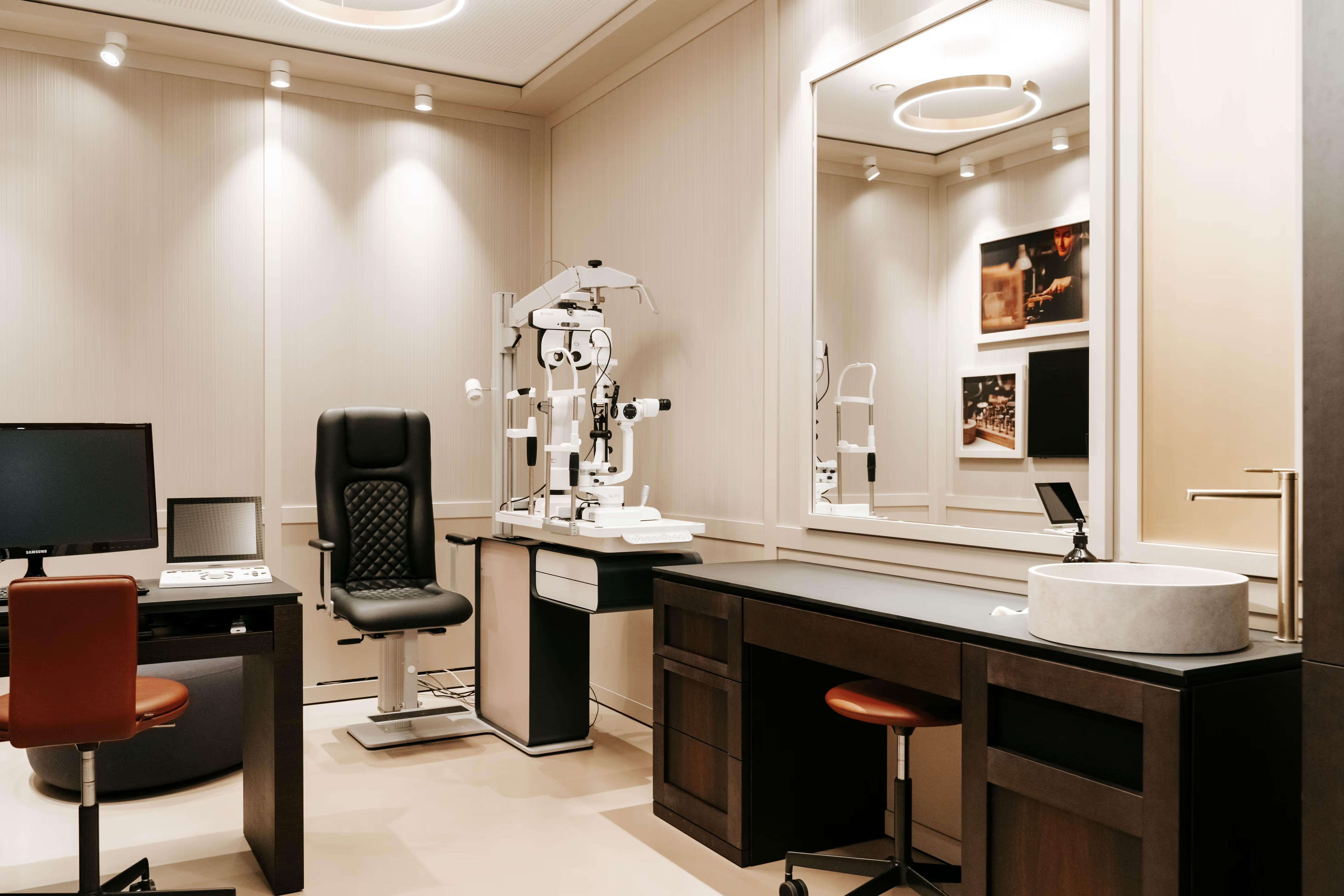
As quality opticians, we rely on biometric vision analysis, precise measurement technologies, and the highest quality progressive lenses the market offers.
Because only when:
- your prescription is precisely determined
- the lenses are centered to the millimeter
- the lens design fits your everyday life
…will the switch to progressive lenses be successful, lasting, and comfortable.
Conclusion: Progressive lenses are not a risk – they are precision.
Yes, there are people who have had bad experiences.
But almost always, it's due to how it's done – not the principle itself.
With:
- detailed analysis
- modern measuring equipment
- high-quality, individually calculated lenses
- consistent wearing during the adaptation period
a successful adaptation is realistic in approximately 95% of cases.
Your first pair of progressive glasses is not an experiment.
It's an investment in comfortable vision – when done right.